
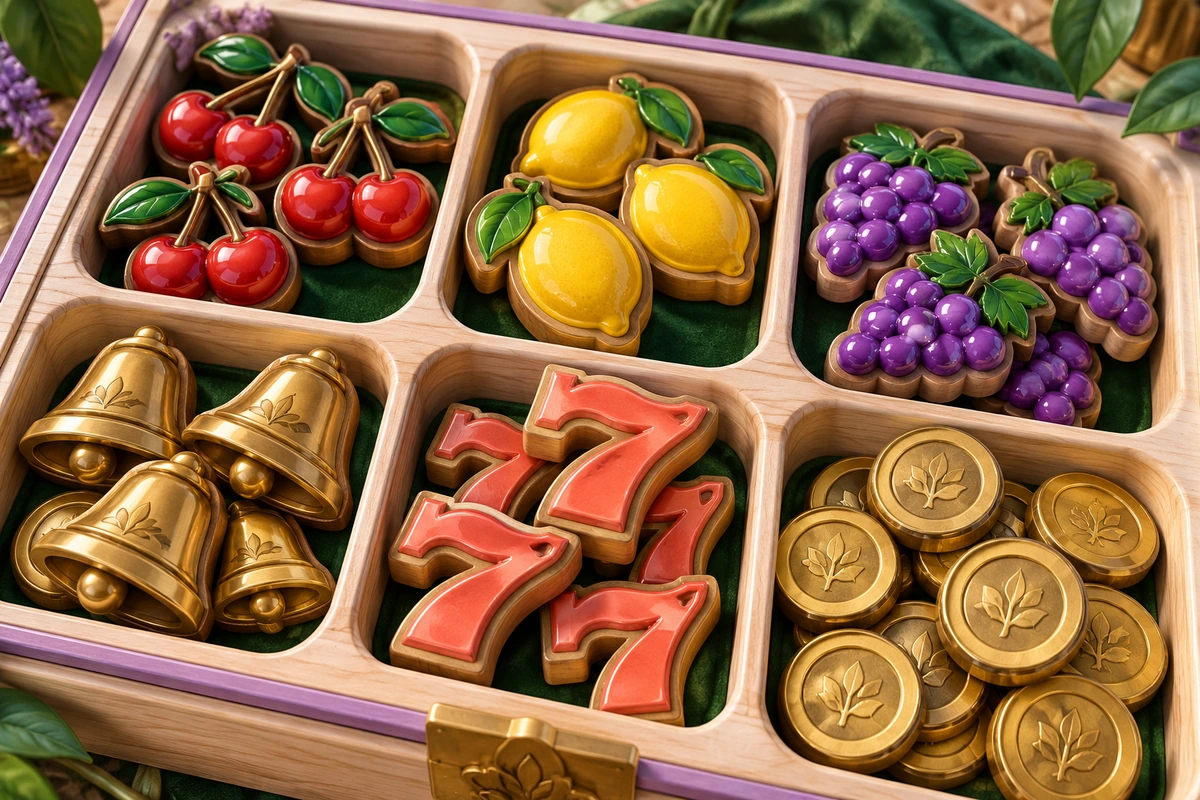
1Recognise the whole family
Cherries appear as a red pair with a stem, Lemon as a yellow citrus shape and Grapes as a purple cluster. Bell uses a rounded brass silhouette, Seven uses a clear numeral and Coin uses a circular stamped emblem. Names accompany the practice symbols so colour is not the only cue.
None of these symbols carries an individual multiplier. Three Lemons and three Bells have the same immediate award. The Coin picture is an emblem on the reel; the separate point discs beside the board record the number of points collected.
2A match earns one emblem
A chosen pattern with two equal symbols earns two point discs and one emblem of that matching type. Three equal symbols earn four discs and still only one emblem. Three different symbols earn one disc without an emblem.
Read only the selected three spaces. Matching pieces elsewhere on the board do not increase the award, and a second pattern is not scored on the same turn. The physical symbols remain attached to the reels; take the collection emblem from the common supply.
3Variety is counted at the end
After your six turns, sort the collected emblems into types. Each type represented at least once contributes two points. Three Cherries pieces and one Bell piece make two different types, so that collection adds four points regardless of the total number of pieces.
Strike may create a choice between improving the immediate coin result and collecting a missing type. When three different symbols are visible, the wildcard can copy any one already present. It cannot introduce an absent emblem solely to complete a collection.